Feed the Machine Credit Card Charge
The Best Credit Card Machines & Terminals For Small Business
Today's credit card processing machines do more than just take payments; they can also give you real-time reporting, analytical data, and more.
Advertiser Disclosure: Our unbiased reviews and content are supported in part by affiliate partnerships, and we adhere to strict guidelines to preserve editorial integrity.

Credit card machines have evolved from having little more than simple transaction processing capabilities to today's high-tech devices with color touch screens, multiple displays, and the ability to install additional software apps to help your run your business. If you want your business to accept credit cards (and you do), you will need a high-quality credit card terminal to process your customers' cards.
This article will explain how much you can expect to pay for a credit card machine and what features to look for. We'll also give you some recommendations for the best terminals available on the market today.
Learn More About Our Top Picks
Read more below to learn why we chose these options.
Table of Contents
- How Much Does A Credit Card Terminal Cost?
- Where Do You Get A Payment Terminal From?
- How Much Should You Really Pay For A Credit Card Machine?
- The Best Credit Card Machines & Terminals For Small Business
- 1. Square Terminal
- 2. Square Register
- 3. Clover Mini
- 4. Clover Flex
- 5. Dejavoo Z11
- 7 Features To Look For In A Credit Card Processing Machine
- Processor Compatibility
- Payment Method Support
- Connectivity Options
- PIN Debit Support
- EBT Payments Support
- Receipt Printer
- Smart Terminal Functions
- How Do I Choose The Best Credit Card Machine For My Business?
- FAQs: Credit Card Machines & Terminals
- How much does a credit card machine cost?
- How does a credit card terminal work?
- Do credit card machines need internet?
- Where can I get a credit card machine for my business?
- How much does it cost to have a credit card terminal?
- In Summary: The Best Credit Card Machines & Terminals For Small Business
How Much Does A Credit Card Terminal Cost?
The credit card processing hardware market today includes a bewildering variety of manufacturers and devices — all of which do basically the same thing. Choices range from basic mobile card readers that require a smartphone or tablet to function all the way up to fully-featured POS systems that can accept payments and run most aspects of your business. Costs are likewise all over the map, with larger devices and additional features adding to the price.
Here's an overview of the capabilities and typical costs of each type of credit card machine on the market today:
| Cost | Pros | Cons | Can Be Reprogrammed? | |
|---|---|---|---|---|
| Mobile Card Reader | $0-$130 | Affordable | May be unreliable & have hardware compatibility issues | Depends on device |
| Traditional Terminal | $130-$500 | Reliable; supports magstripe, EMV, & NFC | Reprogramming issues | Universal models only |
| Smart Terminal | $500-$800 | Additional functionality | Generally not reprogrammable | Usually not |
| Integrated POS | $800-$1,800 | Additional functionality & larger, easier-to-read displays | Expensive; generally not reprogrammable | Usually not |
As of 2022, all new terminals include support for EMV payments. Most new terminals also support NFC-based payment methods (e.g., Apple Pay, Google Pay, etc.) and should be included due to the increasing popularity of this feature.
A built-in printer adds to the cost of the machine but is essential to have so that you can provide paper receipts to your customers. Wireless terminals, while very important for some businesses, are bulkier and significantly more expensive than wired models. You'll also have to pay monthly fees for a wireless data plan. Smart terminals with color touch screens and installable apps are becoming increasingly common but also cost more.
Where Do You Get A Payment Terminal From?
The easiest way to pay for your credit card terminals — and the one that we strongly recommend — is to buy them outright from your merchant services provider. They'll come preprogrammed and ready to use right out of the box, and you'll own them. A universal model can often be reprogrammed to work with a different processing network if you later decide to change providers. While buying your equipment outright is the best option, it can also be costly — especially if you need more than one. Taking out a small business loan might be your best alternative if you don't have the necessary cash for a large, one-time purchase.
Whatever you do, don't agree to lease your credit card terminals. Those seemingly low monthly payments will add up to several times more than the actual value of the machine over the length of your lease, which is noncancelable. Leasing has become so unpopular among merchants that some providers now allow you to rent your terminals on a month-to-month basis instead. While this can also be a very costly option in the long run, it can possibly save you money when you're first starting out.
Be very careful with offers of "free" credit card terminals. Many providers now will essentially loan you a terminal to go with your merchant account. However, you won't own it, and you'll have to return it promptly if you close your account. Also, these terminals usually aren't really "free." You can expect some concession on your part, usually either higher processing rates, a higher monthly account fee, or having to agree to a long-term contract.
How Much Should You Really Pay For A Credit Card Machine?
A word of caution regarding the cost of credit card machines: Don't spend more than you have to. Sales agents are quick to try to upsell you on a more fully-featured (and more expensive) device than what you really need. A machine that meets all of your current needs is going to be a better choice than a more expensive device that comes with features you're never going to use.
To help give you more insight into this topic, we have articles on the best credit card readers for small businesses and how to pick a credit card machine for you to check out.
The Best Credit Card Machines & Terminals For Small Business
The best credit card machines for small businesses support EMV, NFC, and magstripe payment methods. In addition to being rugged and reliable, they're increasingly likely to connect to your processor via a payment gateway, giving you real-time reporting and advanced analytics data.
Our top choices for a payment terminal for your small business are Square Terminal, Square Register, Clover Mini, Clover Flex, and Dejavoo Z11.
1. Square Terminal
| Square Terminal | Visit Site Read our Review |
|---|
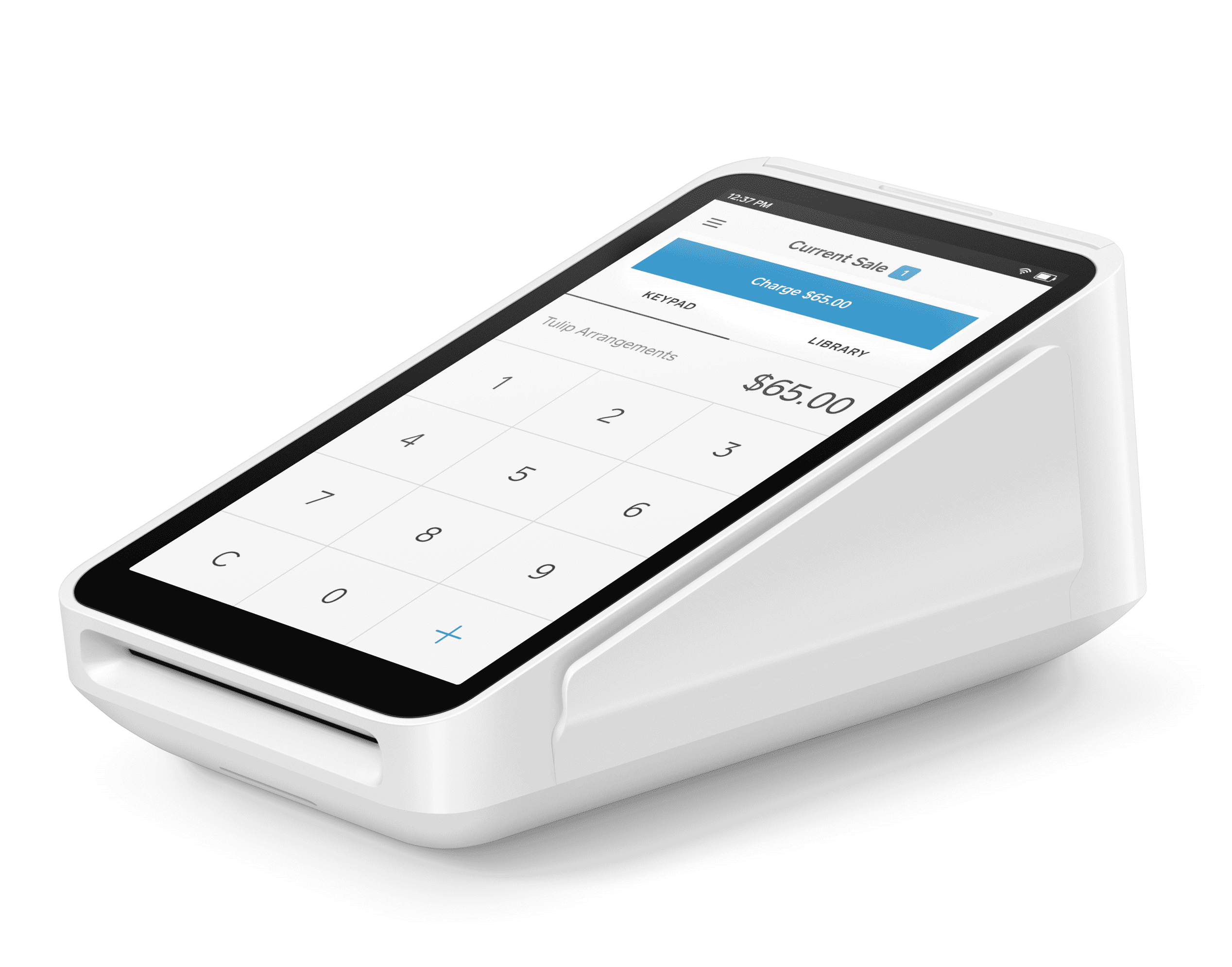
Pros
- Very easy to set up and use
- Accepts EMV, NFC-based, and magstripe transactions
- Includes some basic POS functions
Cons
- Bulky for mobile use
- Account stability issues
Square Terminal Features
Business owners who use Square for credit card processing and want something more advanced than a mobile card reader will find what they're looking for with the Square Terminal. This versatile device offers the following key features:
- 5.5″ color touch screen
- Built-in thermal receipt printer
- Supports EMV, NFC, and magstripe payment methods
- Wi-Fi and Ethernet connectivity
- Rechargeable battery or 110v AC power
Payment Terminal Cost
- $299/unit (or $27/month for 12 months)
- + $39 for Hub for Square Terminal
- +$20 for 20 rolls of Square Terminal Printer Paper
Payment Processing Costs
- No monthly fees
- 2.6% + $0.10/in-person transaction (swiped, dipped, or tapped)
- Custom pricing for businesses processing over $250,000/year
Where Square Terminal Really Shines
Square Terminal is a great choice for small businesses that just need a reliable terminal to accept credit and debit card transactions at their brick-and-mortar location. It also adds several features you won't normally find at this price point, including a stripped-down version of the Square for Restaurants app. While there's no support for Bluetooth peripherals, you can use an optional USB hub to connect a variety of add-ons, including some third-party devices. It's one of the most affordable devices we've found that can function as a mobile or countertop terminal, although it's a little on the large size for mobile use. Square Terminal comes with the Square payments app pre-installed and can be purchased at full price or via interest-free installment payments.
If you're having trouble deciding between this device and the Square Register (see below), check out our guide on Square POS readers and bundles for a side-by-side comparison of every product that Square currently offers.
Get Started With Square Terminal
Read our in-depth review
Jump back to comparison chart
2. Square Register
| Square Register | Visit Site Read our Review |
|---|

Pros
- Accepts EMV, NFC-based, and magstripe transactions
- Expandable via a 5-port USB hub
- Access to Square App Marketplace
Cons
- It only works with Square's processing service
- Account stability issues
Square Register Features
Although it only works with Square's payment processing service, the Square Register is an excellent choice for businesses that need the power and extra functionality of a full point of sale (POS) system.
With Square Register, you'll enjoy the following major features:
- 13.25″ register display
- 7″ customer-facing display
- Wi-Fi and Ethernet connectivity
- Accepts EMV and magstripe payments
- Accepts NFC-based payment methods (Apple Pay, Google Pay, Samsung Pay, and Cash App Pay)
- Supports USB peripherals via an integrated 5-port hub
- Includes Square POS, Square for Retail, and Square for Restaurants (free version) apps
- Expandable via Square App Marketplace
Payment Terminal Cost
- $799/unit (or $39/month for 24 months)
- +$12 for an extended 6.5′ customer display cable
- $299 for a USB receipt printer
- $119 for a USB barcode scanner
- $129 for a 16″ printer-driven cash drawer
- Other accessories and replacement parts available on Square's website
Payment Processing Costs
- No monthly fees
- 2.6% + $0.10/in-person transaction (swiped, dipped, or tapped)
- Custom pricing for businesses processing over $250,000/year
- Additional monthly fees for optional services (Square for Restaurants' paid version, etc.)
Where Square Register Really Shines
Square Register combines the power of a fully-featured POS system with Square's affordable credit card processing service. At $799, this is one of the most affordable countertop POS systems you'll find anywhere — particularly if you don't need any of the company's paid optional services. You will most likely need to purchase some accessories, including a receipt printer and a cash drawer. However, Square offers Square Register bundles that can save you money over buying each product individually.
Unlike most POS system providers, Square uses the same pay-as-you-go billing model, regardless of which hardware product you use. While you might need to add some additional paid services, Square Terminal's built-in software list is very impressive and includes support for inventory management, employee management, loyalty/gift card programs, appointment scheduling, reporting, and eCommerce sales. Special features for restaurants are also available.
There are no additional fees or long-term contracts. However, be aware that Square's flat-rate pricing might be more expensive than a full-service merchant account if your monthly processing volume is higher than about $5000.
Get Started With Square Register
Read our in-depth review
Jump back to comparison chart
3. Clover Mini
| Clover Mini | Visit Site Read our Review |
|---|

Pros
- Easy to set up and use
- Integrated PIN pad and barcode scanner
- Highly customizable
- Expandable with additional apps
Cons
- Requires a Fiserv merchant account
- Usually requires a monthly software subscription fee
- Not reprogrammable
Clover Mini Features
Clover's line of terminals and POS systems have been very popular with merchants due to their ease of use and expandability via the Clover App Market. The Clover Mini combines the expandability of larger Clover POS systems with the form factor of a standard countertop terminal and includes the following key features:
- 7″ color touch screen display
- Uses 110V AC power
- Wi-Fi, Ethernet, and LTE connectivity
- Accepts EMV and magstripe payments
- Accepts NFC-based payment methods (Apple Pay, Google Pay, PayPal/Venmo)
- Supports cash, paper check, and gift card payments
- Includes integrated PIN pad for debit cards
- Includes built-in receipt printer
- Optional cash drawer available
- Includes virtual terminal for keyed-in transactions
- Expandable via Clover App Marketplace
- It can be used as a customer-facing display with Clover Station POS
Payment Terminal Cost
- $749/unit (or three payments of $250)
- $69 for the cash drawer
- $0.00, $14.95, or $44.95 monthly software subscription fee (depending on the plan chosen)
Payment Processing Costs
- 2.6% + $0.10/card-present transaction (through Clover Payments)
- 3.5% + $0.10/keyed-in transaction (through Clover Payments)
- Variable processing fees (through Fiserv or Fiserv ISO)
- Variable monthly and annual fees (through Fiserv or Fiserv ISO)
Where Clover Mini Really Shines
The Clover Mini offers nearly all of the point of sale capabilities of the larger Clover Station Solo/Duo but in a smaller (and less expensive) form factor. It includes most of the "extra" features that you'll actually need right out of the box, with a cash drawer being just about the only accessory you might have to purchase. Like other Clover devices, you can expand the functionality of the Clover Mini by installing additional apps from the Clover App Market. Most of these are free, but some require additional monthly subscriptions.
The Clover Mini is a great choice for businesses that don't need the capabilities of a full-blown POS system but want something more than just a basic credit card terminal. It's not the most affordable option, however, costing roughly twice as much as similar products from competitors and requiring a monthly software subscription fee. Clover Mini is available directly from Clover or through one of several reputable Clover resellers.
Get Started With Clover Mini
Read our in-depth review
Jump back to comparison chart
4. Clover Flex
| Clover Flex | Visit Site Read our Review |
|---|

Pros
- Works for countertop and mobile POS setups
- Supports multiple payment methods
- Expandable via Clover App Marketplace
- Long battery life
Cons
- Large, bulky design
- Requires monthly software subscription fee
- Occasional software bugs and connectivity issues
Clover Flex Features
The Clover Flex bridges the gap between mobile and traditional countertop terminals, functioning equally well in either environment. Like other Clover devices, it comes with a bevy of features and can be expanded even more with apps from the Clover App Marketplace.
Here are the primary specifications:
- 5″ color touchscreen display
- Up to eight hours of battery life
- Wi-Fi and LTE connectivity
- Accepts EMV and magstripe payments
- Accepts NFC-based payment methods (Apple Pay, Google Pay, Samsung Pay)
- Includes built-in receipt printer
- Includes virtual terminal for keyed-in transactions
- Expandable via Clover App Marketplace
Payment Terminal Cost
- $499/unit (or three payments of $166)
- $0.00, $14.95, or $44.95 monthly software subscription fee (depending on the plan chosen)
- $15/month for LTE cellular data plan
Payment Processing Costs
- 2.6% + $0.10/card-present transaction (through Clover Payments)
- 3.5% + $0.10/keyed-in transaction (through Clover Payments)
- Variable processing fees (through Fiserv or Fiserv ISO)
- Variable monthly and annual fees (through Fiserv or Fiserv ISO)
Where Clover Flex Really Shines
If you like Clover's point of sale functionality but need a mobile device, the Clover Flex may be a good choice. With eight hours of battery life, it's ideal for businesses that need to process transactions in the field. The Flex's 5-inch screen is comparable to many smartphones, and you can run any of Clover's many add-on apps. Wireless connectivity is, of course, built into the device. However, it can also function just fine as a countertop terminal if preferred. For truly mobile use in the field, you'll need to purchase an optional cellular data plan.
The ability to install apps and the addition of a built-in printer make the Clover Flex a great choice for businesses that need to accept payments wherever their customers are, although it's rather bulky compared to most smartphones. While the device itself is reasonably priced, the need for a monthly software subscription fee (and possibly a cellular data plan) adds to your overall costs. However, it's an excellent choice for merchants who need these features.
Get Started With Clover Flex
Read our in-depth review
Jump back to comparison chart
5. Dejavoo Z11
| Dejavoo Z11 | Visit Site |
|---|

Pros
- Universal terminal; works with any provider
- Supports EMV, NFC-based, and magstripe payment methods
- Includes integrated PIN pad
- Very affordable
Cons
- Highly variable pricing and contract terms
- Limited "smart" functionality
Dejavoo Z11 Features
If you just want a basic countertop credit card terminal that can securely accept the most common payment methods and don't need all the bells and whistles that come with a "smart" terminal, the Dejavoo Z11 is an excellent choice. It includes all the essential features you'll need to accept credit and debit cards but doesn't include a lot of extra features that you'll never use.
Highlights include the following:
- 3.5″ color touchscreen display
- Connects via IP, dial-up, or Wi-Fi
- Accepts EMV and magstripe payment methods
- Accepts NFC-based payment methods (Apple Pay, Google Pay, Visa payWave, and MasterCard PayPass)
- Includes EMV tip adjust feature
- Includes integrated PIN pad for chip + PIN debit card transactions
- Includes built-in receipt printer
Payment Terminal Cost
- $269/unit (via Dharma Merchant Services)
- Requires additional printer paper rolls (pricing variable)
- No monthly software subscription fees
Payment Processing Costs
Because the Dejavoo Z11 is a universal terminal offered by a wide variety of merchant services providers, transaction processing fees, monthly/annual account fees, and contract terms are all highly variable. Please consult our reviews of individual merchant account providers for additional information.
Where Dejavoo Z11 Really Shines
Not every business needs all the fancy, high-tech features of a modern "smart" terminal. If you just want a simple (and affordable) terminal to sit on your countertop and process basic credit/debit card transactions, the Dejavoo Z11 is an excellent choice. It supports all major forms of credit card acceptance in use today, including all of the most popular contactless digital wallets, such as Apple Pay and Google Pay. The color touch screen, while small, simplifies navigation and makes it easy for you and your employees to use.
Best of all, you won't have to deal with the additional fees that come with many smart credit card machines. Other than refilling the paper for the built-in receipt printer, there are usually no other expenses to worry about.
The Dejavoo Z11 is quite popular with merchants for its simplicity and ease of use but still includes all the features you need to accept credit and debit cards in your business.
Get Started With Dejavoo Z11
Jump back to comparison chart
7 Features To Look For In A Credit Card Processing Machine
Before you decide on a particular type of credit card terminal, you'll want to consider all of the features listed below and how they'll fit in with your business's needs. Here are the things to look for in choosing a credit card machine:
How Do I Choose The Best Credit Card Machine For My Business?
The best credit card machine for small businesses will meet your needs today and support up-and-coming technology trends that will become more important in the future. These trends include NFC capability for contactless payments and the ability to connect to a payment gateway for tokenized in-person transactions.
At the same time, we strongly encourage you to avoid the temptation to choose a merchant services provider because it offers a certain terminal that you like. Fair contract terms, reasonable prices, and excellent customer service are all much more important considerations in the long run.
As we've seen, hardware capabilities don't vary much from company to company. For example, we really love the Clover line of terminals and POS systems and the expanded capabilities they bring to a business. But we've also received many complaints over the years from merchants who signed up with Fiserv (formerly First Data) or one of its less-than-stellar ISOs because they liked the Clover machines. Then they discover that they were locked into a long-term contract, charged exorbitant rates and fees, and offered poor customer service. Worst of all, they couldn't take their Clover equipment to a new provider if they wanted to make the switch.
If you run a retail business and need a good credit card processor, you can find what you're looking for in our post on the best credit processing companies for retail businesses. Good luck!
FAQs: Credit Card Machines & Terminals
In Summary: The Best Credit Card Machines & Terminals For Small Business
- Square Terminal:
- Pros: Very easy to set up & use; accepts EMV, NFC-based, and magstripe transactions; includes some basic POS functions
- Cons: Bulky for mobile use; account stability issues
- Square Register:
- Pros: Accepts EMV, NFC-based, and magstripe transactions; expandable via 5-port USB hub; access to Square App Marketplace
- Cons: Only works with Square processing service; account stability issues
- Clover Mini:
- Pros: Easy to set up and use; integrated PIN pad & barcode scanner; highly customizable; can be expanded with additional apps
- Cons: Requires Fiserv merchant account; usually requires monthly software subscription fee; cannot be reprogrammed
- Clover Flex:
- Pros: Works for countertop and mobile POS setups; supports multiple payment methods; expandable via Clover App Marketplace; long battery life
- Cons: Large, bulky design; requires monthly software subscription fee; occasional software bugs & connectivity issues
- Dejavoo Z11:
- Pros: Universal terminal; works with any provider; supports EMV, NFC-based, and magstripe payment methods; includes integrated PIN pad; very affordable
- Cons: Highly variable pricing & contract terms; limited "smart" functionality
- Bio
- Latest Posts

Frank Kehl has been researching and analyzing merchant services, payment gateways, and international money transfer services since 2015. He has a Bachelor of Science degree from Penn State and a Juris Doctorate from the Ventura College of Law.
Source: https://www.merchantmaverick.com/the-best-credit-card-machines-and-terminals/
0 Response to "Feed the Machine Credit Card Charge"
Post a Comment