Why Did President Johnson Create National Endowment for the Arts
Did you know that the National Endowment for the Arts has advocated for artistic advancement in the United States for over 50 years? Aiming to make art accessible to all, the contained bureau facilitates policies and funds projects that allow Americans from all walks of life "to participate in the arts, exercise their imaginations, and develop their creative capacities."
In recent years, the NEA has become a contentious topic of conversation—both on the political landscape and contemporary art scene. Hither, we take a closer look at this important agency in society to illustrate the ins, outs, ups, and downs of the NEA's federal arts funding.
What is the NEA?

Constitution Center, where the NEA is based (Photo: Stock Photos from 010110010101101/Shutterstock)
Founded in 1965 and based in Washington, D.C., the National Endowment for the Arts, or NEA, is an contained agency of the federal authorities that "funds, promotes, and strengthens" the arts in the United States of America (including U.South. territories).
Funding
Individuals and organizations tin can utilise for NEA grants. Funding granted by the NEA by and large goes to not-profits for specific projects—from performances and exhibitions to arts didactics programs—in a range of artistic fields, similar pattern, media arts, music, and more. In addition to projects, the NEA's financial back up facilitates arts research, special initiatives, partnerships (with land, regional, and federal agencies; philanthropic organizations; and local figures), and lifetime achievement awards.
Accolades granted past the NEA include the post-obit: the National Heritage Fellowship, the highest folk art honor; the NEA Jazz Masters Fellowship for exceptional jazz musicians and experts; and the National Medal of Arts, which celebrates those who are "deserving of special recognition by reason of their outstanding contributions to the excellence, growth, back up, and availability of the arts in the U.s.."
Advisory
The NEA is governed by a president-appointed, Congress-confirmed Chairman. The Chairman serves a four-year term and is brash by the National Council on the Arts, a commission comprising xviii members selected by the President and approved by the Senate. Members of the National Quango on the Arts serve half dozen-year terms.
The chairman is also advised by six members of Congress who "serve in an ex officio, non-voting capacity for two-yr terms." Two of these Congressional members are appointed by the Speaker of the House, and two are selected by the Majority Leader of the Senate. Additionally, i member is chosen by the Minority Leader of the House, and another is appointed by the Minority Leader of the Senate.
Establishment
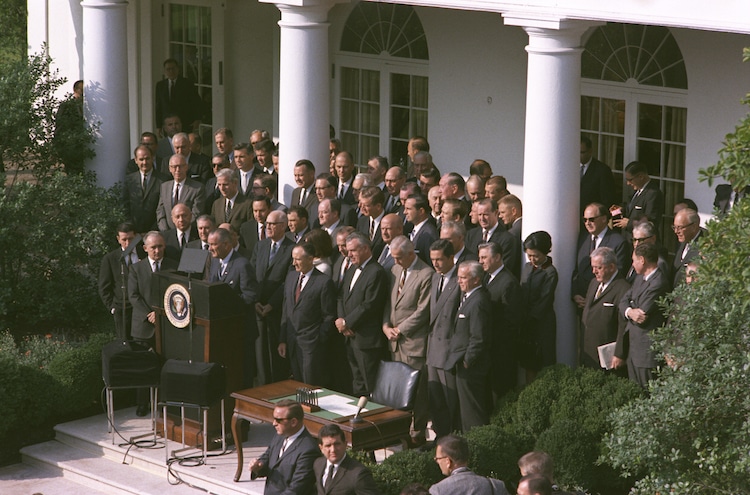
President Lyndon B. Johnson gives remarks at the National Foundation on the Arts and the Humanities Human activity bill signing. (Photo: LBJ Presidential Library [Public Domain])
Taking a cue from Franklin Delano Roosevelt's Federal Art Project—a New Bargain agency that recruited over 8 million people to produce public art that, in plow, boosted the economy—Johnson signed the National Foundation on the Arts and Humanities Human activity into law in September 1965. Proposed past Representative William South. Moorhead of Pennsylvania and inspired by a 1963 report past the National Commission on the Humanities, this piece of legislature established 2 independent agencies approved by Congress: the National Endowment for the Arts andNational Endowment for the Humanities (NEH), which "supports enquiry, educational activity, preservation, and public programs in the humanities."
The NEA Today
In 1965, the NEA appropriated $2,898,308 in grants. In 2020, funding totals $162,250,000—just .003 pct of the federal budget. These funds are split up across 2,400 grants in every Congressional Commune with an emphasis on accessibility. According to the agency, 65% of NEA grants are allocated to small and medium-sized organizations; 40% of programming exists in high-poverty neighborhoods; and 36% of grants go to organizations serving "people with disabilities, people in institutions, and veterans."
As a result of the NEA's efforts, in that location has been a "growth of arts activity in areas of the nation that were previously underserved or not served at all," culminating in the kind of arts accessibility that the country's founders envisioned. "The arts and sciences are essential to the prosperity of the country and to the ornament and happiness of human life," George Washington said in 1781, "They take a primary claim to the encouragement of every lover of his country and mankind."
Still, the NEA's seemingly inalienable being has not been without its challenges. In addition to issues of censorship and controversies surrounding the content of its funded exhibitions, the NEA has faced several threats of elimination: first in 1981 under the Reagan Administration; then in 1995 by House Speaker Newt Gingrich; and, finally, equally recently as this year at the hands of the Trump Administration.
In 2017, 2018, 2019, and 2020, President Trump has sought to entirely abolish the National Endowment for the Arts, the National Commission on the Humanities, the Plant of Museum and Library Services, and the Corporation for Public Dissemination. In each example, nonetheless, both chambers of Congress accept denied his efforts, and the agencies accept connected to brand art accessible to the public—just as Washington, Johnson, and other presidents take intended.
"Nosotros've got to back up our artists and gloat their work," President Obama said in 2015, "and do our part to ensure that the American creative spirit that has divers us from the very starting time will thrive for generations to come."
Related Articles:
How Illustrators Accept Used Their Artwork to React to the Presidential Election of Donald Trump
This Woman Has Been Anonymously Funding Female person Artists for 22 Years
Interview: One Photographer's Behind-the-Scenes Look at the Rise of the Obamas
Source: https://mymodernmet.com/national-endowment-for-the-arts/
0 Response to "Why Did President Johnson Create National Endowment for the Arts"
Post a Comment